Authenticity takes two
2017
Mixed Media Installation '3D Immersion' & Sculptures
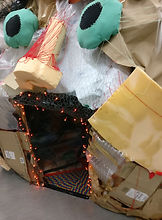
Continuing with the theme of authenticity and developing her practice, Maddock progresses into creating her own experience and questions what makes an authentic human. Taking influences from Christmas Markets, The Puy du Fou, Scaresville experiences, Derren browns ghost train, Historical re-enactments, VR headsets and Lapland. All these experiences in some way convince their audience that what they are experiencing is real. Jeremy Deller, creator of a performance piece re-enacting the battle of Orgreave, referring to the strike of 1984 involving the National Union of Mineworkers. It was staged 17 years later, and some who took part were the original miners. This influenced Maddock’s work into taking a performative route saying: ‘I need to create a work which causes the audience to feel emotion, to question what they are feeling and thinking whilst in the search for a true experience’. The artist questioned what makes an authentic person? Which comes down to traits of the individual, however an authentic person has these key traits: -good morals and listening skills but also expresses beliefs and opinions openly. Yet humans have such depth in the ways of thought and expression which makes Maddock question, whether we even know our true selves. Perhaps, this is a reason as to why humans constantly seek the authentic. In response Maddock created a large-scale sculpture and installation. Experimenting with found materials such as sponge, fur, fake hair and packing materials Maddock produced a large-scale sculptural head. Layered upon a cardboard box and chicken wire structure is the found materials, including a variety of semi-transparent fabrics, in places to show the layering of the human mind and personality which make a body truly human. Stitching covers the layers weaving materials into shape and writing could be found inside of the head questioning the very authenticity of your thoughts and reality. Colourful textured materials spread towards the back of the head to see the piece as having a mask, but also so the piece gains an element of character, which every individual has. The sculpture was then placed with in a large installation piece which was a replica of itself. The structure is completely enclosed, with minimal light on the inside. The interior of the dome was covered in soft materials (paper and colour) with the initial sculpture centred in the middle of the dome. The outside reflects the sculpture within, as the audience enters through the mouth of the giant dome/ head to be confronted with the smaller head that’s exactly the same as the one they just entered. Maddock wants to produce feelings of selfdoubt, what makes them who they are? Do they know what they are capable of? are they truly a good person? She wants them to debate things like this, as it is this, which makes us human. We are meant to have constant doubts and question everything around us as we are always searching for what is real and what is truly authentic in our world, because we can never truly know if it is all just in our heads.




Authenticity
2017
Mixed Media Installation '3D Immersion' & Sculptures
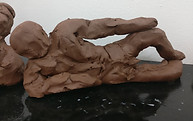
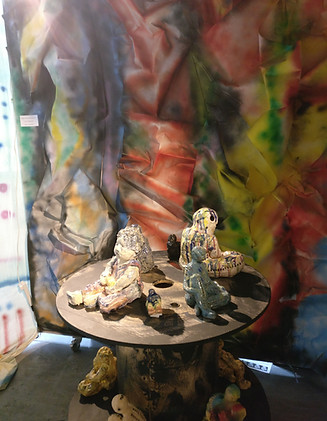
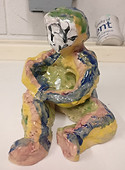
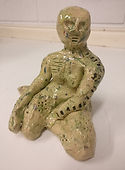
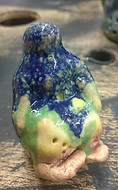
Authenticity is sought and questioned, constantly throughout the world, human nature demands that we question the world around us. So, in our world today, this flaw can be easily exploited, leaving us to question our experiences and emotions. To test whether they are truly authentic or not. Maddock focuses solely on an experience which made her question what she thought and knew as opposed to what she saw. During a trip to Lao (East Asia), where there are several tourist attractions and package deals which 'supposedly' take you to authentic places and a true experience of the 'real Lao culture'. She explores John Urry’s theory of ''The Tourist Gaze''- the idea that tourism is based upon people seeking new experiences and the real way of living, which is opposite to their own, to provide an escape from their normal lives. He also states that many cultures have adapted and taken on the 'gaze' to their own advantage. For example, by employing workers to act and often to create scenarios entirely distinct from any genuine cultural symbols. These deceptions try to masquerade amongst the authentic examples of the culture that the tourist has travelled to see. This piece of research perfectly supports this project, based solely around this 'fake' authentic Lao village. The village resembles a genuine village with numerous people employed and paid very small amounts to live or sit within the village and be subjected to the 'gaze' of the tourists. Tourist take photos of; and with them and are completely taken in by this way of life which is radically different from their own. Often, they don't come realise it's all staged and that they are actually experiencing nothing more than a human zoo. Maddock moves to recreate this experience in her artwork producing ‘3D Immersion’. Combining elements of both sculpture, colour and figurative work and previous experimentations, a series of 16 mini figure sculptures were produced. Each sculpture is based around imagery collected from lao; the positioning has each been previously observed before creating. The series started with a reasonably realistic clay figure getting progressively more abstract, slowly dehumanising the figures. Coating them in colours, first drips, as if they are drowning in their 'culture' and then later, more of a mixing and layering effect was employed to produce some varying works and coloured glazes. This use of colour intrigues the viewer, into this idea that the works are child-like and innocent, however they also have this sinister element, providing an awareness of a dark undertones within the piece. With the given context of what the sculptures represent the work becomes less child friendly and reality dawns upon the audience, enforcing an undeniable sense of guilt and sadness over their involvement of the treatment of these people. The sculptures were then displayed upon cable reels and placed within '3D Immersion'. An enclosed space of colour and sound. Textured paper covers the walls and ceiling finishing with patterned curtains to close off the area. Upon walking in the audience is greeted with this singular stand of sculptures whilst being fully surrounded by this overbearing colourful textural paper installation. They are also hit by audio collected in Lao of music, a key element to traditional village life. The audience will unknowingly take up the role of the tourist and gaze at the figures as if they are real, as if they are the authentic people sitting in the village in Lao. The sculptures are the people and are subjected to the gaze of the audience as they live the experience of what indigenous Lao life is genuinely like. However, it is not real. They are not in Asia. It is of course, an inauthentic situation to which they may not be aware.






Journey to the Afterlife
2016
Mixed Media Installation & Sculptures
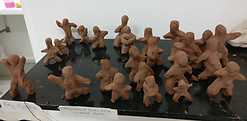
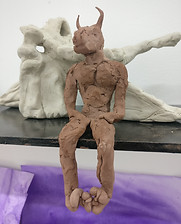
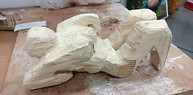
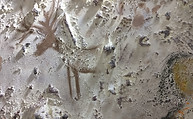
This project explores the concept of the afterlife. Maddock researches the story of the afterlife and what awaits humanity after death from the perspective of multiple religions. She explores this through a diverse and varied number of pieces, including painting, print, drawing, mark making, portraiture and digital collage, film and moving image and moving finally into sculpture. The last outcome to this project was a collection of miniature clay sculptures. The artist toys with religion creating figures of varying sizes and design, assigning each with a very mundane name, such as ‘Clive’, ‘Nigel’ and ‘Barbara’. She presents these characters as Gods creating a religion of her own. From her research, she highlights the continued concept of a greater power that controls all elements of the world we currently live in. This manifests in different ways, in some religions in multiple personalities and in others a single individual. Each figure was made from terracotta recycled clay which was left to dry naturally making the figures increasingly delicate despite them being ‘Godly’. Other figures were made from oak which the artist hand carved from logs. The style of the characters reflects that of prehistoric sculptures which is a key influence on the artists ongoing work. The display of these artworks consisted of Maddock creating a cave wall, covered in cave paintings to reflect the prehistoric style of her sculptures and to highlight the age and necessity of religion and faith itself which has been prevalent since the beginnings of recorded history and has continued unwavering to the present day.
.jpg)